



Blog

Challenges and Innovations in Cell Culture: Growing the Most Difficult Cell Lines in History

Sven Bocklandt, Ph.D. Species Director and Anthony Mastracci IV, Associate Researcher from Colossal Biosciences recently joined Cell Microsystems for a webinar titled “Reviving the past, safeguarding the future: challenges and innovations in cell culture.”

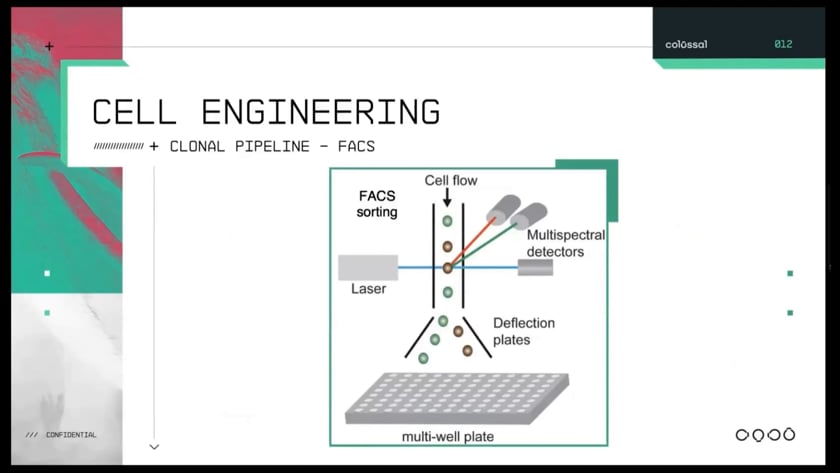
In many labs across the world, fluorescence-activated cell sorters (FACS) have remained the gold standard instrumentation for cell line development and gene editing workflows. While FACS is perhaps the most well-established automated methodology, cell sorters can present technical challenges such as:

  • The need for a dedicated highly skilled operator
  • Cross-contamination between experiments
  • Lengthy run times, which can lead to significant financial burdens and bottlenecks


In addition, for many difficult-to-culture or sensitive cell types, high-pressure fluidics-based sorting can lead to loss of cell viability, phenotypic drift, and the inability to recover rare cells.

Faced with some of these changes, Colossal Biosciences looked for an alternative technology that would augment their flow-based workflows and alleviate these pain points. Colossal discovered CellRaft Technology, a gentle and cost-effective solution for their issues.

In this webinar, Colossal scientists describe the changes to their workflow upon integrating CellRaft Technology and discuss new avenues that were not previously attainable with FACS. Take a look below as Dr. Sven Bocklandt and Anthony Mastracci IV explain how CellRaft Technology automated and instilled confidence in their workflows.

1882480091 a62e95588fba2cadc265eba7aae2a3aeec0b8e43c2546176fb0b5fe56de000c7 d 840?region=us

How does CellRaft Technology isolate cells more gently than FAC sorting?

FACS

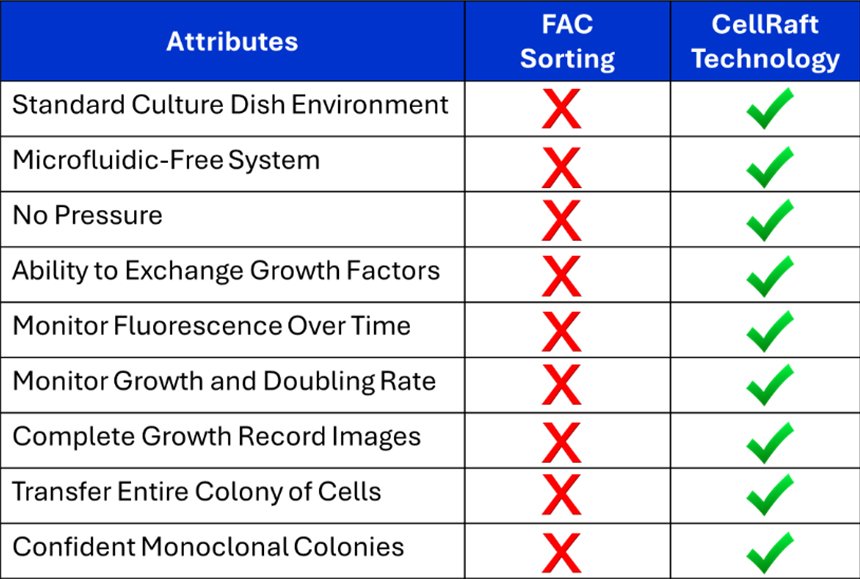
To isolate cells to make monoclonal cell lines, the standard in the field really is to use FACS or fluorescence activated cell sorting. That puts several stresses on these cells. They sit in a sorting buffer sometimes for a long time, they're exposed to high pressure during the sorting, and then importantly they end up alone in a well without the ability to secrete and share growth factors with other cells.

CellRaft AIR

We are using the CellRaft AIR, from Cell Microsystems to isolate cells in a way that is more gentle than FAC sorting. We seed cells onto a culture plate that is made up of thousands of microscopic rafts where they share the media and thus they can keep exchanging growth factors as if they are in a standard cell culture dish. We were concerned about cells transferring between wells, but we’ve been able to confirm the cells maintain monoclonality.

logo crisper black
Anthony Mastracci IV
Associate Researcher
1882536707 9e9b4cdb98ffa121e0a0aef16e7eb0fa1a9b324577b9ee27b367bdf5733c7073 d 840?region=us

How did CellRaft Technology automate Colossal’s manual workflow?

FACS

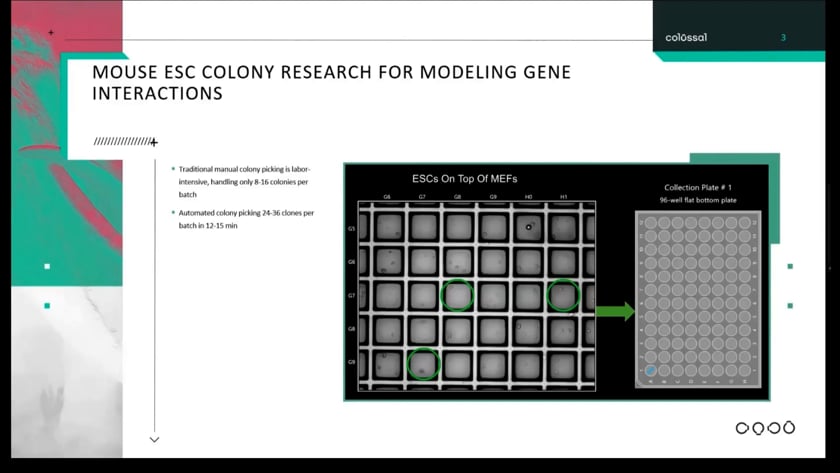
Cloning mouse embryonic stem cells is a tedious process of spending hours hunched over a stereoscope, meticulously using a P20 pipette to manually pick clones from a 6-well flask or larger. It is quite labor-intensive and places a significate strain on our scientists, consequently diverting their attention from higher-level tasks.

CellRaft AIR

Upon implementing the CellRaft, we immediately noticed its ability to automatically pick clones of interest. This, in turn, freed up our scientists to focus on other lab tasks. Now the ability to observe individual ESLs just four hours after seeding expands our editing workflows and instils greater confidence in our research. This enables us to explore new avenues that were previously inaccessible.

logo crisper black
Anthony Mastracci IV
Associate Researcher
1882561128 d0f9e218e117e9debe1f7290b125faba84df38d57ee08ba5d9b17b694ab62570 d 840?region=us

How does CellRaft Technology ensure monoclonality?

FACS

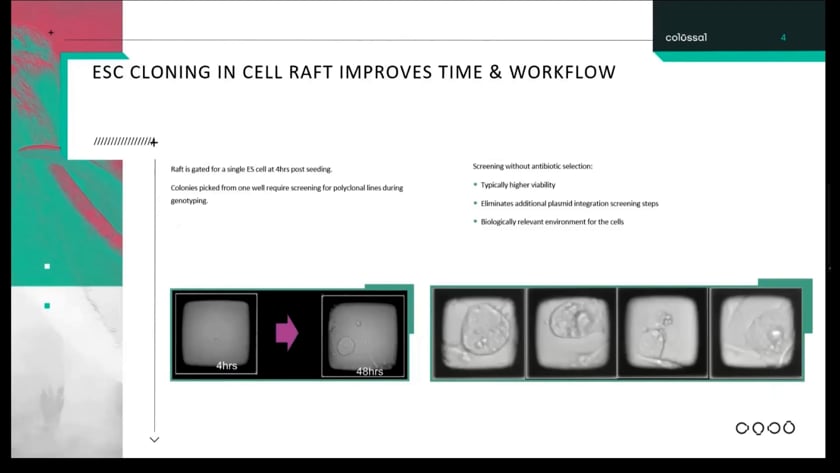
Our approach involved seeding ESLs at low density on a six-well plate, followed by waiting seven to nine days before examining under the stereoscope. This method occasionally resulted in the formation of polyclonal lines when two ESLs either landed in close proximity to one another or failed to fully dissociate appearing as a single colony days later. Consequently, screening for polyclonal during genotyping became necessary.

CellRaft AIR

Now using CellRaft Technology, we have the ability to visualize single ES cells just four hours post-seeding possessing greater confidence in the monoclonal nature of colonies being generated. And as matter of fact, since implementing the CellRaft, we have yet to encounter a polyclonal ES colony.

logo crisper black
Anthony Mastracci IV
Associate Researcher
1883381254 bbf29503e89d622691b9edd22f93e346c24ef1f723d0c6a1fcaa79d4ec5d1a89 d 840?region=us

How does CellRaft Technology aid in gene editing workflows?

CellRaft AIR

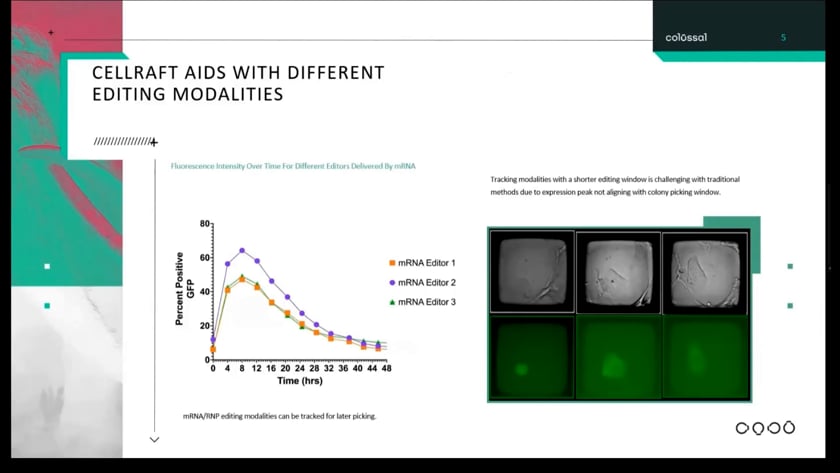
mRNA has a short editing window peaking at around eight hours and tapering off over the course of 48 hours visualizing early ESL transfections. We can see the tapering off of the fluorescence begining to fade resulting in low SNR. This now demonstrates to us that we can start using fluorescence for positive selection for mouse ESLs.

logo crisper black
Anthony Mastracci IV
Associate Researcher
Colossal Blog

Upon implementing CellRaft Technology, Colossal automated their clone picking, noticed cells were more viable within their natural environment, and could visualize earlier within the short editing window. They were able to avoid excessive costly screening, having confirmed monoclonal colonies in their hands. These advantages demonstrate the flexibility, ease of use, and confidence Colossal has in the CellRaft Technology. Colossal now has the ability to accelerate their research freeing up scientists from constantly sorting, re-analyzing, or additionally screening their cells.

To see more information on the technology that helped Colossal accelerate their workflows and enable their scientists to focus their attention back to higher-level tasks, visit our website and read about CellRaft Technology.

Lexi Land B.S. 300x300 1
Lexi Land, B.S.
Research Associate II | lland@cellmicrosystems.com

Lexi Land contributes to developing scientific workflows that are compatible with the CellRaft® AIR System. Her focus at Cell Microsystems involves stem cell research, 3D organoid work, as well as adherent and suspension cell culture. Lexi received a Bachelor of Science in Biological Sciences from North Carolina State University with a focus in molecular, cellular, and developmental biology.

Related Posts

Single Cells: Lab Tune Sung to the Rhythm of "Jingle Bells"

By Jessica Hartman, Ph.D.

Toiling in the lab

With a deadline on its way

To the scope I go

On a Saturday

I don’t see a clone

I’ve looked for one that’s right

What misery these data bring,

I’ll have to look all night,

Oh! Single cells, single cells, dilutions aren’t the way

Oh, I wish I had an AIR to pick a clone, to-da-ay!

Single cells, single cells, I need a better way

Use a Raft to grow a clone or be sad this holiday!

Use a Raft to grow a clone or be sad this holiday!

Now it’s getting late

My spirits are so low

My PI will hate

If my cells don’t grow

My eyesight’s getting dim

A clone I cannot see

My chances are so slim

I need CellRaft Cytometry

Oh! Single cells, single cells, sorters aren’t the way

Oh, I wish I had an AIR to pick a clone, to-da-ay!

Single cells, single cells, I need a better way

Use a Raft to grow a clone or be sad this holiday!

Use a Raft to grow a clone or be sad this holiday!

Oh! Single cells, single cells, dispensers aren’t the way

Oh, I wish I had an AIR to pick a clone, to-da-ay!

Single cells, single cells, I need a better way

Use a Raft to grow a clone or be sad this holiday!

Use a Raft to grow a clone or be sad this holiday!


 “Single Cell” vocalist: Virginia Laurie
Jessica Hartman, Ph.D.Senior Director of Product Applications | jessica.hartman@cellmicrosystems.comDr. Jessica Hartman has a B.S in Biology from the University…
Lessons Learned Growing Clones From Over 100 Cell Lines 
Historically, cell line development has predominantly relied on a limited number of cell lines such as CHO-K1, HEK293T, and HeLa.…
Kite Pharma’s Single Cell Cloning Process Improved
The satisfaction that comes from seeing a carefully designed experiment unfold and coalesce into a clue, an answer, or a…